• Skip to primary navigation
  • Skip to main content
  • Skip to primary sidebar
  • Skip to footer
projectsgeek

ProjectsGeek

Download Mini projects with Source Code, Java projects with Source Codes

  • Home
  • Java Projects
  • C++ Projects
  • VB Projects
  • PHP projects
  • .Net Projects
  • NodeJs Projects
  • Android Projects
    • Project Ideas
      • Final Year Project Ideas
      • JSP Projects
  • Assignment Codes
    • Fundamentals of Programming Language
    • Software Design Laboratory
    • Data Structure and Files Lab
    • Computer Graphics Lab
    • Object Oriented Programming Lab
    • Assembly Codes
  • School Projects
  • Forum

Project Ideas

Final Year Project on Web Issue manager

October 13, 2011 by ProjectsGeek Leave a Comment

Final Year Project on Web Issue-manager 


Web Issue-manager for distributed teams

Project Definition

“ Web Issue-manager for distributed teams “

Final year Project Statement

Issue Manager is a web-based application designed to help a workgroup keep track of issues and tasks via a shared central resource. The data is stored centrally on the server, which make it specially suitable for distributed teams who can use just the web browser to access it. No local software needs to be installed on the client and all web browsers are supported.

Brief Description of Final year Project

Strategic issue management is the responsibility of the entire organization. That responsibility crosses all units and all reporting lines. It is the external component of strategic management.
This issue management framework involves three functions:
  • Gathering/Monitoring intelligence and information
  • Analyzing the information and classifying the issue
  • Taking action and evaluating the results
Issues are events that occur outside the control of an organization and that may require the organization to take action.
For effective strategic management , issues need to be classified and ranked.

Classification

Classification determines whether the problem is internal pr external and routes it accordingly
Ranking determines the priority order for dealing with and expending resources on an issue.
The purpose of the issue resolution process is to provide a mechanism for organizing ,maintaining and tracking the resolution of issues that cannot be resolved at the “individual” level. The approach consists of issue control mechanism and a well definied Process that enables the project team to identify ,address and prioritize problems and issues. All action items will be tracked until they are resolved.
The issue Manager will report on all open issues at the weekly status meetings. If the list of issues is too long only the new issues will be discussed. At times, it may be advisable to pre-distribute issues information so that the project status group can review the material before the meeting.When the issue of problem has been resolved and verified , the actual date problem was resolved and an approval signature complete the issue resolution process, and the issue is Closed.

System Requirement

Platform:- Windows
Software Requirement
  • IIS
  • Microsoft access
  • .NET Framework SDK Beta2/ASP.NET Premium Edition Beta2
  • Winzip or similar program

Hardware Requirement:

  • Local area network configuration
Web Issue Manager-Final year Project


Other Projects to Try:

  1. Online Time Sheet Final Year Project Idea
  2. B tech final year project-Source Code Analyzer
  3. Internet E-mail System and P2P Computing-final year projects for cse
  4. Detecting SNMP service on a network Final Year Project
  5. Package Manager-B tech final year project

Filed Under: Final Year Projects Tagged With: Project Ideas

Package Manager-B tech final year project

October 13, 2011 by ProjectsGeek Leave a Comment

Package Manager A B tech final year project


Package Manager for Source Code Installation 

Project Description

Our goal is to introduce a Package Manager for Source Code Installation in Linux distributions. This Package Manager would itself take care of maintenance of complete system, which so far has been a very cumbersome job for any administrator. This LPM along with a Registry would provide an alternative back-end for various text configuration files.
Thus, instead of each application having its own text-configuration files, our application provides a universal, hierarchical, fast & consistent namespace & infrastructure to access configuration parameters through a key-value pair mechanism.
This would include creation of separate entities:-
  • local database for local machine administration & maintenance.
  • registry for local as well as remote administration of the machine configuration.

Architecture

  • I386 Architecture Machines.
  • Red Hat Linux 9.0 Operating System.

1.3 Project Requirements

The project has some hardware & software requirements that are described as follows:-

1.3.1 Software Requirements

  • Red Hat Linux 9.0 with kernel(2.4.23)
  • Linux GUI builder package – QT
  • A C/C++ IDE for Linux – Anjuta
  • Elektra API’s

1.3.2 Hardware Requirements

  • Two PC’s with usual configurations (128/256RAM P4 Processors etc.)
  • LAN connection b/w the machines.

1.4 The Problem

It has been long desired to have some kind of Package Management system in existing Linux environment. Due to the pre-existing feature of being Open Source, any package can be installed & used, almost anywhere in a Linux system (be it Personal/Server configuration).
Today’s GNU/Linux systems are a sum of independent components collected from Open Source Community. Each of them already has a working, but selfish configuration system.

1.5 A Basic Scenario

One of the system (maintained by an administrator X) has an Apache package (say version 1.4) installed from source (instead of RPM distribution).After some time a new administrator (say Y) starts maintaining that system. Suppose he comes to know that Apache (version 1.4) has a serious security flaw and he installs a newer version (2.0). Now to clean the system more efficiently he has to effectively delete all the files (main files as well as support files) from various locations which become a very tedious task itself.
Thus we realize that the overall maintenance of complete Linux system is a highly cumbersome process which any administrator has difficulty in carrying out, both efficiently & effectively.

1.6 How the problem has been attacked

Now that the problem at hand is very much clear, the next & foremost step is as to how the information about various packages, getting installed on the system, needs to be track down & stored. One of the most important design issues that needs utmost attention is:-
The existing system should not change. It means that we cannot go about changing the entire installation methodology, just for the sake of obtaining the desired information. The reason is if the existing system changes, there is a high probability that the newer system is not at all welcomed by the existing developer & user society.
Thus after considering various other issues, the solution that has been finalized is as follows:-
We need to trap the information when & where it is getting created & moved into the existing system.
This information then has to be stored & later on retrieved in an efficient & effective way that would suite our project requirements.
Thus the complete project now gets divided into 4 different stages. They are:-
  • Collection of all the data.
  • Extraction of Information.
  • Efficient storage of the information.
  • Effective retrieval of this information.

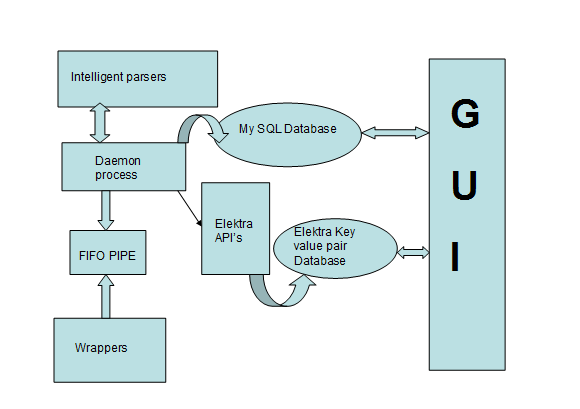
1.7 Architectural Design

Package Manager-B tech final year project 1


Other Projects to Try:

  1. Final year engineering projects Ideas for CSE
  2. Detecting SNMP service on a network Final Year Project
  3. B tech final year project-Source Code Analyzer
  4. Final Year Project on Web Issue manager
  5. Linux Package Manager Project Idea

Filed Under: Final Year Projects Tagged With: Project Ideas

B tech final year project-Source Code Analyzer

October 13, 2011 by ProjectsGeek Leave a Comment

Source Code Analyzer-b tech final year project

Source Code Analyzer project

Introduction

The purpose of this document is to collect, analyze and define high-level needs and features of the Source Code Analyzer. It focuses on the capabilities needed by the stakeholders, and the target users, and why these needs exist. 

Input to this source code analyzer will be a windows code and as an output it’ll give us graphical view of amount of portable source code, non-portable source code.

Purpose of Source Code Analyzer

In order to comply with this kinda working knowledge of different operating systems is must because one just can’t simply use the same program for different operating systems. One has to again write that program taking into consideration compatibility issues. This is not always possible. Here idea of porting comes into the picture.

We’ve discovered that there are no tools available to check the compatibility issues; ergo we’ve decided to design software that will analyze a program and give us an information regarding parameters needed to be considered while going for porting. This software is called source code analyzer.

Summary of Capabilities

SCA will be providing a launch pad for a porting project. It will indicate the comparative study of the existing code. SCA will assist management to identify problem areas and gauge staff workload. The reports generated by SCA allow high level review of problem status.

SCA will assist the programmers too as it provides the readymade reverse engineered documents of existing code as well as special guidelines for porting that code on the other platform.

Objectives

Manual analyzing of source code is a very time consuming and tedious. SCA attempts to reduce this process of analyzing the existing code, provides various reports, graphs, suggestions, which are extremely useful not only for developers but for management personnel also to decide the deadline, and number of employees to be assigned.

Platform:


  • Jdk 1.4
  • Software requirements:
  • Gel IDE


Hardware requirements:


  • PROCESSOR: PENTIUM III/IV.
  • MEMORY: 256MB onwards


Source code analyzer final year project for cse

Other Projects to Try:

  1. Network Monitoring System-final year projects for cse
  2. XML Based Encryption Filesystem Final year Project
  3. Package Manager-B tech final year project
  4. Final Year Project on Web Issue manager
  5. Mobile Banking Final year Project Idea

Filed Under: Final Year Projects Tagged With: Project Ideas

Secure Virtual Drive-Final year projects for cse

October 13, 2011 by ProjectsGeek Leave a Comment

Secure Virtual Drive A Final year projects for cse


Project Definition

Implementation Of Secure Virtual Drive
Project Statement To reinforce the discretionary access control mechanism on Windows 2000 through the creation of secure Virtual Drives.

Brief Project Description

Motivation and Objectives Windows 2000 has two forms of access control over objects. The first form—discretionary access control—is the protection mechanism that most people think of when they think of protection under Windows 2000. It’s the method by which owners of objects (such as files or printers) grant or deny access to others. When users log in, they are given a set of security credentials, or a security context. When they attempt to access objects, their security context is compared to the access control list on the object they are trying to access to determine whether they have permission to perform the requested operation.
Privileged access control is necessary for those times when discretionary access control isn’t enough. It’s a method of ensuring that someone can get to protected objects if the owner isn’t available. For example, if an employee leaves a company, the administrator needs a way to gain access to files that might have been accessible only to that employee. In that case, under Windows 2000, the administrator can take ownership of the file so that you can manage its rights as necessary.
With a privileged access control over objects, a user with administrative privileges can tamper with the files of other users, make changes in them or even delete them. There are situations where this privileged access of a user over objects is not only undesirable but can also cause heavy damage to the organization (consider a user modifying a tender document). An organization prefers to rely on the system than trusting those with administrative privileges.
We are trying to reinforce the discretionary access in WINDOWS 2000, which enables a user to protect his/her data from being tampered by users with privileged access to the system. Our project is driven by the concept of polyinstantiation of common resources leading to strong separation of users.

Our Solution

The easiest solution that comes to the mind is to provide the user with encryption software. Whatever documents the user wants to protect he simply encrypts it. Even the administrator cannot decrypt this document.
But if one looks carefully at the issue one finds that the administrator can still corrupt or delete the user’s data. Also the existence of the data can be known. Then also if we look from the point of view of the user’s convenience he has to explicitly specify which files need to be encrypted.
Our aim is to provide the user with a convenient mechanism to protect his data. We are providing every user his/her own secure virtual disk drive inaccessible and invisible to every other user, even the system administrator. The secure virtual drive is like a safe or a vault, what is inside it is known and accessible only to the owner.

Software and Hardware Requirements:

  • Win-2000 Operating System
  • Driver Development Kit(DDK)
  • Softice Debugger
  • OSR Loader
  • DBGView
Final year project for CSE-Secure Drive


Other Projects to Try:

  1. Final Year Project-Tracking System project
  2. Network Monitoring System-final year projects for cse
  3. Internet E-mail System and P2P Computing-final year projects for cse
  4. Final year engineering projects Ideas for CSE
  5. Virtual Earth Inside final year project

Filed Under: Final Year Projects Tagged With: Project Ideas

Network Monitoring System-final year projects for cse

October 13, 2011 by ProjectsGeek 2 Comments

Final year projects for cse

NETWORK MONITORING SYSTEM

Final year Project statement 

          To develop a network monitoring system that allows the administrator to be able to categorize and monitor the resources on its network.
Technology : C# .Net technology
 
BRIEF DESCRIPTION OF Network Monitoring System
 
Any large Business entity has a number of locations. To run the business they have an IT structure in place. Each of these locations is part of the IT structure either through a LAN, WAN, VPN etc. The IT structure consists of resources like servers, workstations, laptops, hand-held devices, printers and networking devices that connect them like switches, Routers, Bridges etc.
Most of these resources have attributes such as name, manufacturer, Operating system, processor family, RAM, connections to other resources – Fiber-optic cable, RS232 serial cables, coaxial cables etc.
We need to implement a utility for mapping the network topology, the attributes can be queried from database or by network exploration and presenting them in graphical format to users. The idea is provide an IDE that will help our users to quickly draw n/w diagrams, identify resources uniquely and edit attributes on them. Also, we must be able to keep history of changes to the resource attributes.
It should maintain a database which contains all the resources along with the attributes that were present the last time the network was scanned. This database should be updated dynamically whenever the network is scanned or a resource or attribute is moved / changed. Whenever a user wants to change any attribute he should be provided with a tag where he can enter any relevant details about his status at the present time.
It provides for an Administrator who has full control over the entire network,or a part of it,(centralized control with partial distribution of rights depends on purpose). The administrator can start or stop dedicated services, he can update the required software from one central location, on his part of the network.

 Components Of The Project 

1. GUI based application:
  • This provides the facility to user to initiate the utility, whereby he will get a graphic detail of the entire network. He will be able to visualize every resource on his network and will be able to see every possible connection between resources.
  • He will be able to able to see all the attributes present on any resource he wants.
  • He will be able to update, modify, change or configure the resources with the help of objects representing the actual resources present on the network. This triggers a background process of history keeping.
  • It provides the ability to caution any change of an attribute which may not be compatible with the resource at hand.

2. Back end Processing :

  • This module uses various Algorithms to find the various attributes on every resource.
  • It also maintains a dynamically updated database which contains all the attributes present on every resource along with compatibility problems.
  • This module handles all functionality from finding the resources, attributes, querying with the resources  to re-configuring the resources
  • It can therefore take decisions on compatibility issues and report errors accordingly.
  • We can use raw IP packets in novel ways to determine what hosts are available on the network, what services (application name and version) those  hosts are offering , what operating systems (and OS versions) they are running, what type of packet filters/firewalls are in use, and dozens of other characteristics.  It provides complete information about configuration , processes, applications along with their attributes like compatibility , version , status etc.

3. Manager :

  • It provides synchronization between the activities of the user (GUI) and the Backend.
  • It bridges the way in which the GUI displays all the information the Back end provides.
Platform : WINDOWS 2000/XP
Software requirements:
The application should be web based so that it could be deployed on web server
Possible Tools that could be used-:
  • ASP
  • Visual basic
  • Microsoft  Visual Studio .Net
  • IIS service
  • C#

Hardware requirements:

  • PROCESSOR : PENTIUM III/IV , CELERON 1 GHz , AMD ATHLON
  • MEMORY : 256MB onwards
  • Modem / LAN card (100Mbps)
  • Internet connection
Network Monitoring System-Final year project for CSE

Other Projects to Try:

  1. Secure Virtual Drive-Final year projects for cse
  2. Internet E-mail System and P2P Computing-final year projects for cse
  3. Final year engineering projects Ideas for CSE
  4. Networking Projects for Computer Science
  5. Detecting SNMP service on a network Final Year Project

Filed Under: Final Year Projects Tagged With: Project Ideas

Internet E-mail System and P2P Computing-final year projects for cse

October 13, 2011 by ProjectsGeek Leave a Comment

Final year projects for cse

Internet E-mail System Using P2P Computing

Free final year projects SYNOPSIS 


Problem Definition To build a software the can be used to communicate between   persons who are separated geographically. It has to transfer files from one resource center to another with trust and security that should indirectly support distributed computing.
 Technology :- Java  And  JXTA . JXTA is open source and freely distributed, and JAVA is also freely distributed.

Software Requirements  

  • Java Development Kit(1.3 or later)                                 
  • Java Achieve Files

Hardware Requirements

  • Hard disk.
  • Any network based on TCP/IP protocol.
  • O.S And Platform Independent
  • 64 MB RAM.
  • Pentium-II  400mhz or later microprocessor.
  • MODEM  (to be tried over internet)

Brief Description of P2P Computing

 There are products available in market that facilitate either instant messaging, file transfer or remote controlling of a system. Our project efforts to bring all these facilities under one roof and to allow them interoperate within themselves.
Our main aim is to build a software the can be used to communicate between   persons who are separated geographically. It has to transfer files from one resource center to another with trust and security which would indirectly facilitate distributed computing.
We will use JAVA/JXTA technology to build our software. JXTA is a technology, which enables to build a peer-peer application without much considering the underlying aspects.
JXTA defines a series of  XML message formats or protocols. Peers use these protocols to discover each other, advertise and discover network resources, and communication and route messages. There are six JXTA protocols:-
  • Peer Discovery Protocol
  • Peer Information Protocol
  • Peer Resolver Protocol
  • Pipe Binding Protocol
  • Endpoint Routing Protocol
  • Rendezvous Protocol
JXTA peers are not required to implement all six protocols; they only need implement the protocols they will use. The Java programming language API is used to access operations supported by these protocols, such as discovering peers or joining a peer group.
 We will also use java archive files such as:-
  • jxta.jar
  • jxtasecurity.jar
  • beepcore.jar
  • cryptix32.jar
Internet E-mail System-Final year Project Downlaod

Other Projects to Try:

  1. Networking Projects for Computer Science
  2. Application Independent Caching final Year project
  3. Secure Virtual Drive-Final year projects for cse
  4. Network Monitoring System-final year projects for cse
  5. Final year engineering projects Ideas for CSE

Filed Under: Final Year Projects Tagged With: Project Ideas

  • « Go to Previous Page
  • Page 1
  • Interim pages omitted …
  • Page 4
  • Page 5
  • Page 6
  • Page 7
  • Go to Next Page »

Primary Sidebar

Tags

.Net Projects Download Android Project Ideas Android Projects Angular 2 Assembly Codes C # Projects C & C++ Projects C++ Projects Class Diagrams Computer Graphics Database Project Data Mining Projects DataScience Projects Datastructure Assignments Download Visual Basic Projects Electronics project Hadoop Projects Installation Guides Internet of Things Project IOS Projects Java Java Interview Questions Java Projects JavaScript JavaScript Projects java tutorial JSON JSP Projects Mechanical Projects Mongodb Networking Projects Node JS Projects OS Problems php Projects Placement Papers Project Ideas Python Projects seminar and presentation Struts

Search this Website


Footer

Download Java Project
Download Visual Basic Projects
Download .Net Projects
Download VB Projects
Download C++ Projects
Download NodeJs Projects
Download School Projects
Ask Questions - Forum
Latest Projects Ideas
Assembly Codes
Datastructure Assignments
Computer Graphics Lab
Operating system Lab
australia-and-India-flag
  • Home
  • About me
  • Contact Form
  • Submit Your Work
  • Site Map
  • Privacy Policy